Home / Shop

- Description
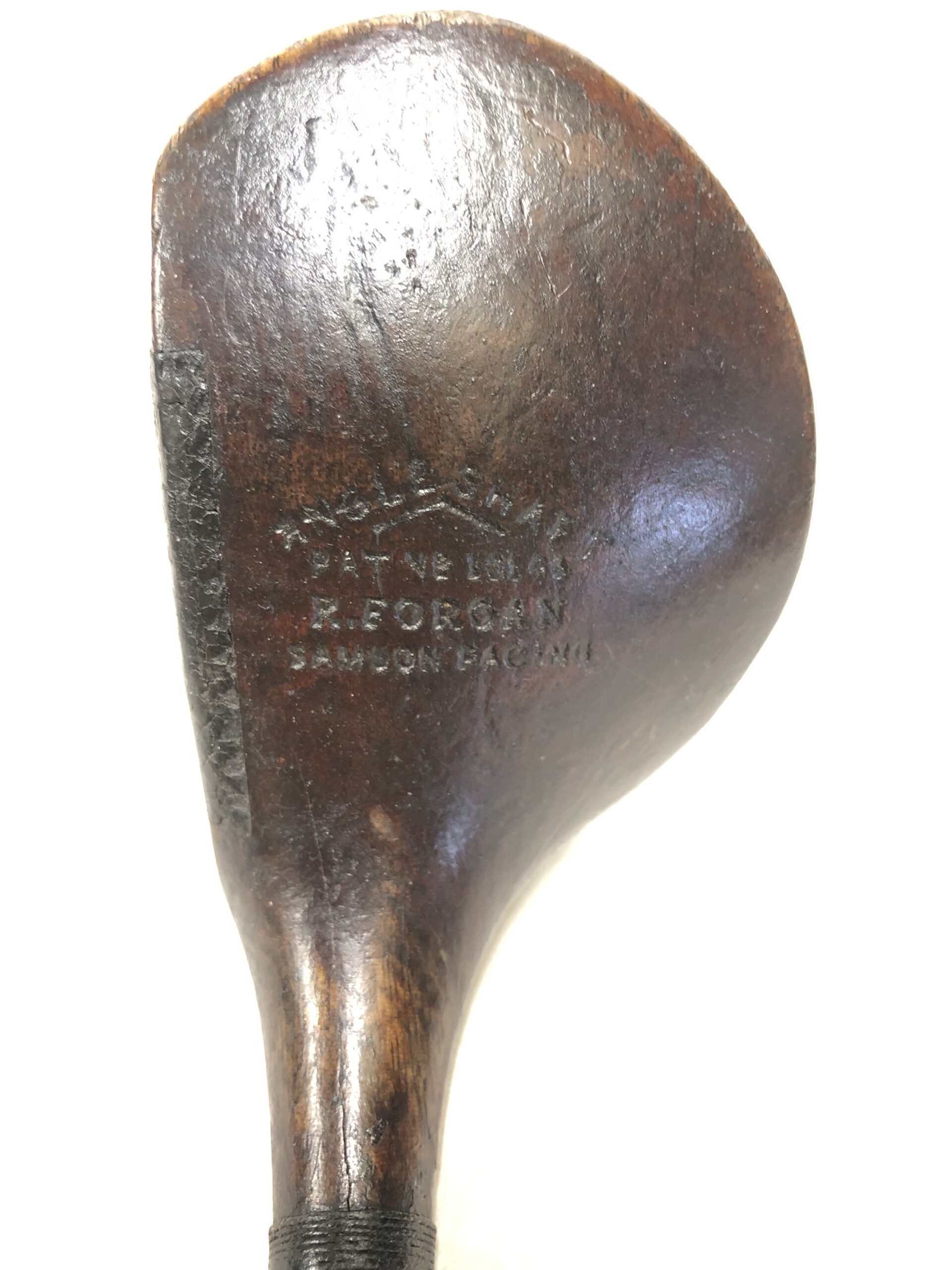
Club: R. Forgan & Son 'Angle Shaft' Driver with 'Samson Facing' Insert
Maker: Robert Forgan & Son, St. Andrews, Scotland.
Year: c.1912
Shaft: Original, reasonably straight oval shaped hickory shaft stamped 'R.Forgan, St. Andrews', and 'Patent No. 10194' . Vintage grip.
As this is an 'Angle Shaft' club, the axis of the oval is not square with the face, but turned through roughly 25 degrees to the right (see patent description and details below).
Length: 41.5"
Loft: 10 degrees
Condition: Very good for age. Clear name stamp to head and shaft. A fine crack is visible on the neck running up under the whipping.
Other details:
Robert Forgan was one of Scotland’s finest clubmakers, having learned the skills from his uncle, Hugh Philp, who is regarded as the greatest of all longnose clubmakers. He intially worked for, and then took over, the business on his uncle’s death in 1856. In 1863 Forgan was appointed clubmaker to H.R.H. Prince of Wales, and thereafter stamped his clubs with the Prince of Wales plume of feathers. The stamp changed to a crown mark in 1901 when the Prince became King Edward VII and this was used until 1908. The Robert Forgan workshops overlooked the famous St. Andrews golf course.
A collectable club, and inovative concept, this Albert C. Fowler ‘Angle Shaft’ was patented in Britain on 6th April 1910 (No. 10194) and made by Robert Forgan & Son, St. Andrews.
The utopian intention behind Fowler’s design was (to quote his U.S. patent application) produce a shaft “which will drive the ball greater distance and at the same time straight”.To achieve this aim Fowler’s shafts were oval in shape for most of their length – the oval beginning at the top of the head socket, up to approximately 2” under the lower part of the grip. Also, the axis of the oval was not square to the face, but turned to the right, through roughly 25 degrees. In addition, the head is slightly ‘closed’ or ‘shut’. The idea was thus described in Fowler’s U.S. patent;
“As soon as the rearward stroke is begun, the wrists turn naturally so as to throw the head of the club backward…….In my invention it will be seen that the greatest width of the shaft is thus brought in the direction of the stroke except when the club head is near the ball, so that the greatest rigidity of the shaft is maintained during the forward stroke until just before the ball is struck. The shaft is therefore kept from bending backward and the clubhead is thus prevented from lagging behind the handle, or such bending of the shaft and lagging of the club head is reduced to a minimum. The club head is therefore held up to its work. Just before the ball is struck, the wrists turn naturally forward into the position assumed when addressing the ball, and as the least width of the shaft is now only slightly inclined to the direction of the stroke, springiness or whip will then be imparted to the shaft, so that the ball will be driven a greater distance and at the same time slicing will be obviated. The slight inclination of the face in the reverse direction to a vertical plane passing through the shaft and the head of the club (i.e. a hooked face) overcomes the tendency of this club to drive a straight ball slightly to the right.”
This example of an Angle Shaft Driver by Robert Forgan & Son has the addition of the “Samson Facing” woven fabric insert. The insert was the invention of Phillip Edward Samson who obtained a British patent (No. 11744) for it on 15th May 1911.
The unique material qualities of this insert were said to “drive the ball further and reduce the ‘slicing’ and ‘pulling’ caused by the ball slipping on the face, more noticeable in wet weather”. The exact composition of the material used in constructing the inserts seems to have varied in the beginning, but basically consisted of woven or plaited fabric (such as cotton, wool, jute, hemp and even hair!) impregnated with a non-vitreous enamel, which was then baked at a high temperature.
Many leading golfers of the day utilized ‘Samson Facing’ clubs, and certainly had great success with them. The top three finishers at the 1911 Open Championship at Sandwich; Harry Vardon, and Arnaud Massy and Alec Herd who tied third, all used the inserts in their drivers and brassies. The insert was also used by Harold H. Hilton when he won the U.S. Amateur Championship in 1911.
A separate U.S. patent for Samson’s insert was applied for on 8th April 1912, and granted April 14th 1914. American examples of woods using the insert can be found, made primarily by the Crawford, McGregor & Canby Company of Dayton, Ohio, who used them for a short period of time.
Ref: The Clubmaker’s Art – Jeffrey Ellis, and Collecting Antique Golf Clubs – Peter Georgiady.